
Hard water is pickpocketing your soap budget.
Ever feel like you're pouring money down the drain every time you do laundry, shower, or wash dishes? Turns out — you might actually be. Hard water doesn't just leave crusty buildup on faucets and scale inside your water heater. It quietly drains your wallet, one bottle of detergent at a time. Here's the soap test that proves it.
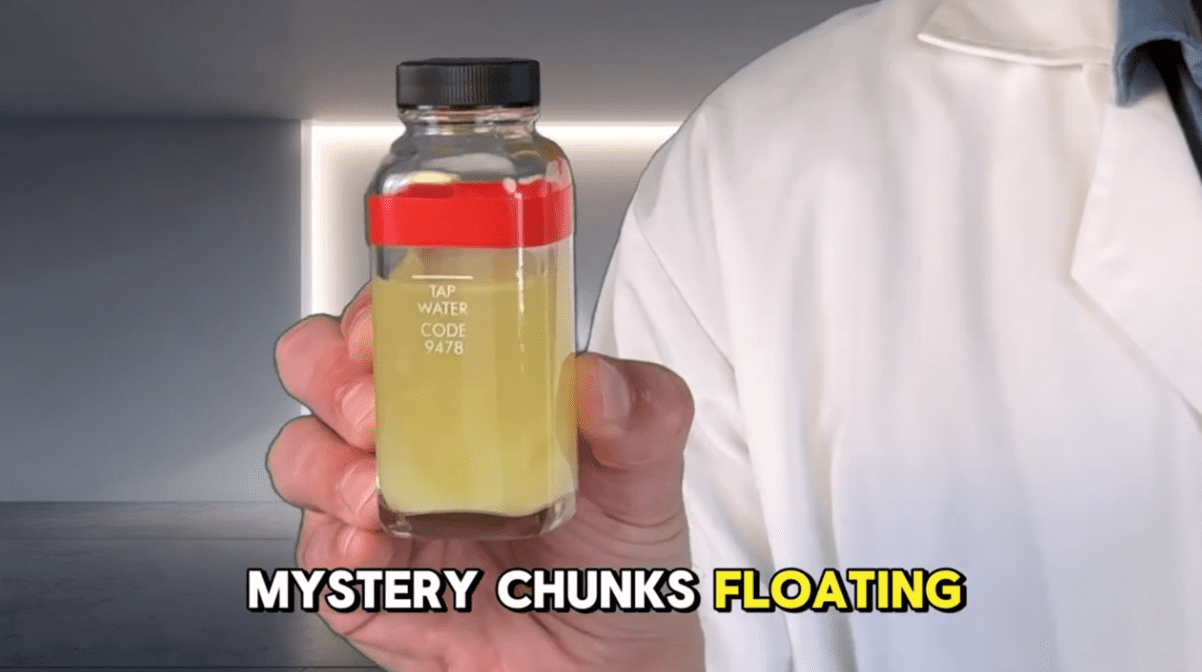
The Soap Test: two cups, three drops, one obvious winner
In the video above, Ryan runs a simple kitchen-counter experiment that homeowners can replicate themselves: two clear containers, two identical samples of water from the same Ohio home — except one's been treated through a water softener and the other is straight from the tap. Three drops of soap go into each. Then the shake.
The treated water foams up instantly. Soap is doing exactly what soap is designed to do: lift dirt off surfaces, suspend it in lather, and rinse cleanly away. The tap water? Barely a film. Soap's there, but it's not lathering — it's wrestling with the calcium and magnesium dissolved in the water before it can even start cleaning your clothes.
Then comes the punchline: four times the amount of soap in the tap water. Theoretically, that should clean four times better. It doesn't. The water itself is the problem.
Why soap stops working in hard water
Soap molecules have two ends: one that loves water, one that loves grease and dirt. In soft water, those molecules form lather and surround particles of dirt and oil, lifting them off your skin, clothes, or dishes so they can be rinsed away.
In hard water, the calcium and magnesium ions get there first. They bond with the soap molecules and form an insoluble gunk — that's where "soap scum" comes from. The soap is now chemically locked up. It can't lather. It can't lift dirt. The only way to compensate is to dump in more soap, hoping enough of it escapes the calcium-magnesium reaction to actually clean something.
What this is actually costing you
Industry estimates suggest homes with hard water use roughly 50% more soap and detergent on average — and many homes use 3–4× more, especially where hardness runs 10+ gpg, which covers much of central and southern Ohio.
Here's what that looks like for an average family of four:
It's not just money — it's slime, scale, and skin
The same soap scum that costs you product also doesn't disappear after you use it. It sticks. To your tub, your shower walls, your clothes, your skin. That slimy film you scrub off the bathtub every weekend? That's not "dirt." That's the chemical byproduct of soap reacting with hard water minerals. In a softened-water home, that film simply doesn't form.
On clothes, the residue gets trapped in fibers — making them stiff, fading colors faster, and giving fabrics that "we tried" feel even after a wash. On skin, it leaves a thin layer that dries out the surface, which is why so many people in hard-water homes assume they have sensitive skin when really they just have residue.
The soft-water version of life
When you actually fix the water at the source — at the main water line coming into your home — everything downstream gets easier. Soap lathers. Clothes feel softer. Glassware comes out of the dishwasher clear instead of spotted. Showers feel different in a way that's hard to describe until you've had it both ways.
The savings on cleaning products start the day the softener goes in. The appliance lifespan gains compound over years. And the gross part — the soap film and scale buildup you've been fighting since you moved in — just stops happening.
How to know if your water is the problem
The simplest way is also free. Pure H2O offers a free in-home water test for any Ohio home — about 30 minutes at your kitchen sink. Our WQA Certified Water Specialists test your specific tap for hardness, chlorine, iron, TDS, and visible indicators. You leave with the actual numbers for your address, in writing.
Find more about your local water profile by city:
- Columbus water treatment — Central Ohio, including chloramine treatment
- Cincinnati water treatment — Cincinnati and Northern Kentucky service
- Dayton water treatment — including Mad River well field PFAS coverage
- Ohio water reports by ZIP code — type your ZIP, see what's known about your local water
Common questions
How do I know if my water is hard without a test?
Quick clues: soap doesn't lather well in your shower, there's a ring or film on your bathtub, your glassware comes out of the dishwasher with white spots, scale builds up on faucets, and your skin or hair feels different after using the same products at a soft-water hotel versus at home. Any one of these is a strong indicator. The free in-home test gives you the actual number.
Will a softener really save me 50% on cleaning products?
For most Ohio homes, yes — often more. The exact savings depend on your specific hardness number and how much laundry, cleaning, and showering happens in your home. The savings on cleaning products alone typically cover the cost of a softener within 3–5 years. Everything after that is money back in your pocket.
What about salt-free water conditioners?
Salt-free conditioners are different from softeners. They reduce scale buildup by altering how minerals deposit, but they don't actually remove hardness — so soap performance doesn't improve the way it does with a true softener. If your goal is cleaner laundry, better lather, and skin that doesn't feel coated after a shower, you want softening, not conditioning.
Is the free water test really free?
Yes. We use EPA-approved methods at your kitchen sink and hand you the numbers in writing, and the test costs you nothing. Most Ohio homeowners have never seen the real numbers for their own water — once you do, what to do about it gets a lot simpler.
Find out what's really in your water.
A free 30-minute in-home water test. EPA-certified methods, real numbers for your address, explained in plain English.
Schedule My Free Water Test →