
Your Ohio water, explained in plain English
The taste. The spots on your glasses. The dry skin after a shower. There's a reason for all of it — and it can change street to street across Ohio.
What's actually wrong with your water?
Smell, taste, stains, dry skin, low pressure — every symptom has a cause. Pick what you're noticing, or let a free in-home test tell you for sure.
Smelly water
Chlorine, sulfur "rotten egg," or musty odors — often disinfectants or gas.
See the likely causes →Bad taste
Metallic, chemical, or flat-tasting water at the kitchen tap.
See the likely causes →Stains
Orange (iron), black (manganese), or blue-green (copper) marks.
See the likely causes →Dry skin & hair
Skin that never feels clean and an itchy scalp — usually hardness or chlorine.
See the likely causes →Low pressure
Weak flow after a filter went in — sizing, cartridges, or plumbing.
See the likely causes →Health concerns
Worried about PFAS, lead, or nitrates? Start with a clear testing plan.
See the likely causes →Match what you're noticing to what's probably causing it
These are the patterns we see most often in Ohio homes. They're a starting point for a conversation — not a diagnosis. A test at your tap is what confirms it.
👃 Smelly water — chlorine, rotten egg, or musty
A "pool" or bleach smell is usually chlorine or chloramine — the disinfectant your utility adds to keep water safe on its way to you. It's doing its job; most people simply don't want to taste or smell it at the tap.
A "rotten egg" smell typically points to hydrogen sulfide gas, which is far more common on private wells. If the smell shows up only on the hot side, the water heater's anode rod may be involved rather than the water itself.
Musty or earthy odors can come from seasonal changes at the source — reservoirs and rivers behave differently in late summer than in spring — or from something in the home's own plumbing or drain.
What usually helps: a whole-home carbon filter for chlorine and taste/odor, or a well water system for sulfur. Which one depends entirely on what the test finds.
💧 Bad taste — metallic, chemical, or flat
Metallic or "penny" taste often traces back to metals picked up in plumbing — iron, copper, or in older homes, lead from service lines and solder. Metals rarely come from the source; they get in on the last leg of the journey.
Chemical or medicinal taste is usually disinfectant related, and it can shift month to month as treatment is adjusted or the source blend changes.
Flat or "nothing" taste isn't a contaminant at all — it's often just what treated municipal water tastes like once you're used to something else, which is why so many people notice it right after moving.
What usually helps: most taste complaints are solved at the kitchen tap with reverse osmosis drinking water, since that's where you actually drink from.
🟠 Stains — orange, black, or blue-green
Orange or rust-colored staining in sinks, tubs, and laundry points to iron. It's extremely common on Ohio wells and shows up on porcelain and white fabrics first.
Black or dark brown specks and streaks usually mean manganese, which often travels with iron and stains at much lower concentrations.
Blue-green marks around drains and fixtures indicate copper, which typically means the water is mildly corrosive and is dissolving a little of your plumbing on the way through.
White, crusty buildup around faucets and showerheads is a different story — that's hardness scale, not a stain, and it's the most common water complaint in Ohio.
What usually helps: iron and manganese need targeted filtration such as an EC5 OxyTech well system; scale is a job for a water softener. Corrosion signals are worth a closer look at pH before anything gets installed.
🧴 Dry skin & hair — that "never quite clean" feeling
Two things drive most of this. Hardness minerals — calcium and magnesium — react with soap to leave a film that rinses off poorly, which is why skin can feel tight or filmy and hair feels heavy. Chlorine is drying on its own, particularly in a hot shower where more of it comes out of solution.
The tell is usually elsewhere in the house: spotty glassware out of the dishwasher, soap that won't lather, stiff towels, and scale on the showerhead. If you're seeing those, hardness is very likely part of the picture.
It's also the symptom homeowners most often live with for years without connecting it to their water at all.
What usually helps: a water softener for hardness, often paired with whole-home carbon for chlorine. See how they work together in a home package.
🚿 Low pressure — weak flow after a filter went in
If pressure dropped noticeably after equipment was installed, the equipment is usually the place to start. The three common causes are a system sized too small for the home's peak demand, cartridges or media past due for service, and a bypass or valve left in the wrong position.
If pressure has always been low, or it's low at only one fixture, it's more likely plumbing than treatment — an aerator clogged with scale, a partially closed shutoff, or an old galvanized line.
Worth knowing: a correctly sized system should not cost you noticeable pressure. If yours does, that's a fixable problem, not something to live with.
What usually helps: if you already have equipment, start with a service request or an RO filter change. If you're evaluating a new system, sizing is the question to ask about first.
🛡️ Health concerns — PFAS, lead, nitrates
These aren't things you can taste, see, or smell, which is exactly why they cause worry. The right response isn't to guess — it's to build a short testing plan around your actual situation.
Lead is a plumbing issue, not a source issue. It matters most in homes built before the mid-1980s and in areas with lead service lines still in the ground. It requires a lab test; there's no home indicator. Ohio has one of the largest counts of lead service lines in the country, and replacement runs well into the 2030s — we cover the timeline in lead water lines in Ohio.
PFAS are the "forever chemicals" in the news. They're monitored and reported by public water systems and require certified lab testing to measure at your tap.
Nitrates are primarily a private-well concern in agricultural areas, and they matter most for infants and during pregnancy.
What usually helps: start with your utility's published report or our Ohio water report by ZIP code to see what's known for your area, then decide what's worth confirming by lab. For drinking and cooking water specifically, reverse osmosis is the most common point-of-use answer.
Know the cause before you buy anything
Guessing at treatment wastes money and rarely fixes the real issue. We start with your symptoms, confirm them with a free in-home test, and only recommend a solution when the results back it up.
- Symptoms first, confirmed by testing
- Results explained in plain English
- Solutions only when the data supports it
- No pressure to buy anything
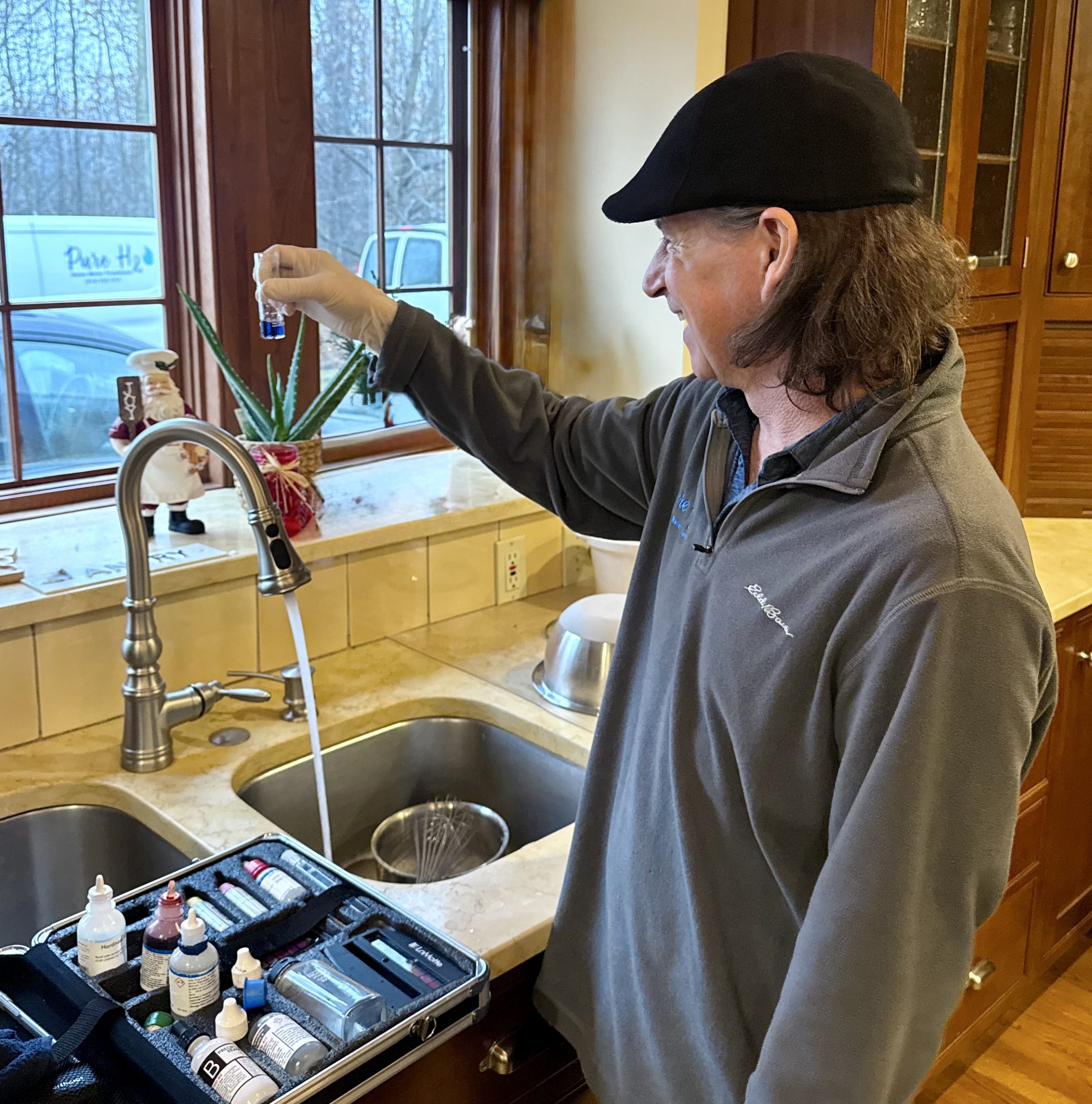
What the in-home test covers
- Hardness — scale and appliance wear
- Chlorine and disinfectant levels
- Iron and staining clues
- pH and corrosion signals
Takes about 30–45 minutes at your kitchen sink. For contaminants like lead or PFAS, we'll tell you honestly that those need a certified lab — and help you figure out whether it's worth doing.
Two homes on the same street can have very different water
Where it starts, how it's treated, and the pipes it travels through all change what reaches your tap. Central Ohio leans heavily on surface water, which is why taste and odor shift with the seasons there and why chlorine or chloramine residual is part of the picture year-round. Southwest Ohio and private wells behave differently again.
Source blending
Many Ohio systems mix water from more than one source, and the ratio shifts through the year.
Seasonal shifts
Rain, runoff, and reservoir turnover change what treatment has to handle month to month.
Distance traveled
Water at the end of a long distribution run isn't identical to water near the plant.
Your home's plumbing
Pipe age, material, and fixtures shape the final few feet — the part no city report can see.
The city report is a great start — but it isn't your faucet
City reports describe the water leaving the plant, averaged over time. Your pipes and fixtures shape what actually reaches your glass.
The takeaway: utility data is the big picture. An in-home test shows what's happening at your tap.
Two different questions
The city report answers: "Is the water this system delivers meeting federal standards, on average, over the reporting period?"
An in-home test answers: "What is coming out of this faucet, in this house, today?"
Untreated vs. treated water — side by side
Once you know what to look for, it's hard to un-see.
Living with the problem
- Scale on faucets, showerheads, and the coffee maker
- Spotty, cloudy dishes straight out of the dishwasher
- Dry skin and hair that never feel fully rinsed
- Soap and detergent that take more product to work
- Water heater and appliances wearing out early
After the right solution
- Spot-free dishes and clearer glassware
- Softer water — skin and hair feel different in a week
- Better-tasting water and ice at the kitchen tap
- Less soap, less detergent, less scrubbing
- Plumbing and appliances protected from scale
Neighbors helping neighbors since 1999
Local specialists who've tested thousands of Ohio homes. No scripts, no pressure — just a clear look at your tap.
No idea how hard our water was until the test. Zero pressure — and our dishes actually come out clean now.
Jennifer M. — Central OhioHe knew our area's water before he even tested it. Honest about our options, never pushy. Earned our trust.
Ryan T. — Greater ColumbusWe moved and the water tasted different right away. Pure H2O showed us exactly what was in it. The kids notice the difference every day.
Sarah K. — Southwest OhioOhio water quality & home impact — FAQ
Why does my water taste or smell different than last month?
Seasons, source blending, and treatment adjustments all shift the water — and distribution distance and your home's plumbing change how it feels at the tap. A noticeable month-to-month change is common and usually isn't cause for alarm on a public system.
Do public water reports show what's coming out of my faucet?
Not exactly. Reports are system-wide averages over time. A point-in-time in-home test shows what's actually at your tap, after the water has passed through your service line, your pipes, and your fixtures.
What's the biggest "home impact" issue in Ohio?
Usually disinfectant taste and odor, plus hard-water effects like scale and spotting. It varies by region, which is why local context matters — and why we look at your area before we look at your equipment options.
How do I tell whether my problem is hard water or something else?
Hard water has a consistent signature: white crusty buildup on faucets and showerheads, spotty glassware, soap that won't lather, and stiff laundry. If you're seeing staining instead — orange, black, or blue-green — that points to metals rather than hardness, and it's a different fix. A hardness reading takes about a minute during an in-home test and settles the question.
Is well water treated the same as city water?
No — wells aren't regulated like city supplies, so testing and treatment are up to the homeowner. Well water also tends to bring a different set of issues: iron, manganese, sulfur odor, and in agricultural areas, nitrates.
Will a water treatment system hurt my water pressure?
A properly sized system shouldn't cost you noticeable pressure. When pressure drops after an install, it's usually undersized equipment, overdue cartridges or media, or a valve left in the wrong position — all fixable. Sizing is a fair question to ask any company before you buy.
What's the most practical first step?
Confirm the readings for your specific concern, then match a solution to the outcome you want. A free in-home test is the easiest start — about 30–45 minutes, no cost, and no obligation to buy anything.
See what's in your water — free
A local specialist, real results, zero pressure. Tell us where to reach you and we'll take it from there.
Prefer to call? (614) 819-0340
Serving Central Ohio — Franklin, Delaware, Licking, Fairfield, Pickaway and Union counties — plus Greater Cincinnati and the Dayton area.